The 5 Phases of Music Production - And Why Mixing and Recording Don't Mix
Mix Artist Studio Newsletter October 2026
Dear Artists and Music Creators,
Every music production is different - and that's a good thing. This said, there are some workflows that are better than others. In this newsblog, I'd like to share workflows that have stood the test of time.
Let's start with workflows I'd advise against. Example: a friend of mine (great EDM muso) asked me for some feedback on their production. The conversation started with: "The mastering engineer added some new backing vocals and edited out some MIDI data".
That made me scratch my head, I had lots of questions. Adding and editing performances is not the mastering engineer's job. Who was that mastering engineer? (Turns out that was another EDM producer)
And how come the recording and editing wasn't completed, before the mix and before the master? And how did the so-called "mastering engineer" ended up with the DAW session in the first place?
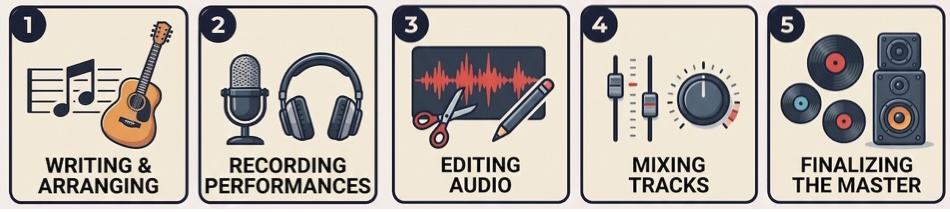
Well, working with modern DAWs has blurred the boundaries between the production phases:
- Song writing + Arranging
- Performing + Recording
- Editing
- Mixing
- Mastering
|
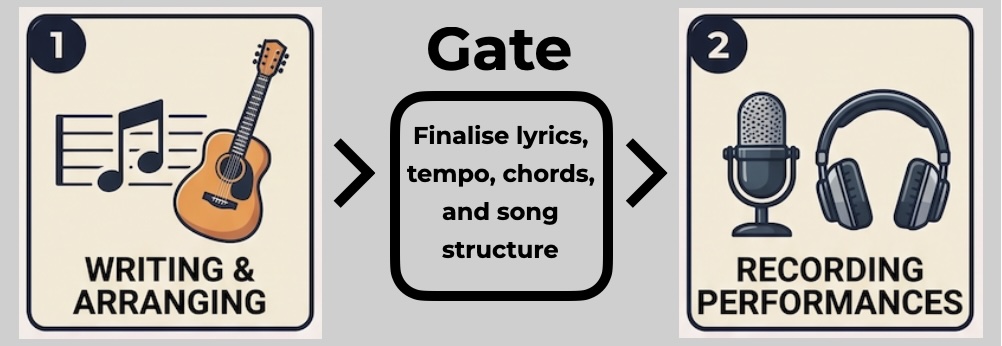
You probably already know where I'm going with that. The same principles can be applied very successfully in music production. And I do apply those principles when working with clients at Mix Artist Studio (although I wouldn't share the back story in this much detail).
A clear separation between the production phases not only gives clear focus on what we are here to achieve today - but it also gives everyone the freedom to NOT focus on any other distracting things. And that can be a godsend for achieving music performance flow state in a recording studio.
Let me sum up a blue print of what that means for the production phases, what is in focus and what should not be in focus. Yes, I know, those are rubbery guidelines, not set in stone.
Song writing / Arranging
Where: best done at home or in the rehearsal room, in the lead up to the studio recording session.
What's in focus: The song, the lyrics and the right message/vibe. Work on the lyrics, leave enough space for the imagination to fill gaps. Visualise who the story teller is, associate yourself with that (imaginary) person, learn to fall into character.
Define the parts of the song clearly, map out the arrangement. Check the overall length of the song, is there anything you should shorten? Remember, listeners have a short attention span and you need to get to the hook/chorus relatively quickly. Leave the 9-min arrangement with 64 bar intro for live gigs - in the studio, consider short & punchy.
Map out the instrumentation clearly. Make sure everyone's playing the same chords and the band agrees on a feel-good tempo for the song.
What's NOT in focus: Production-trickery, complex effects, automation, mixing, mastering - don't even think about it!
Technology: As simple as possible! Eg. sheets of paper and a basic mobile phone recording.
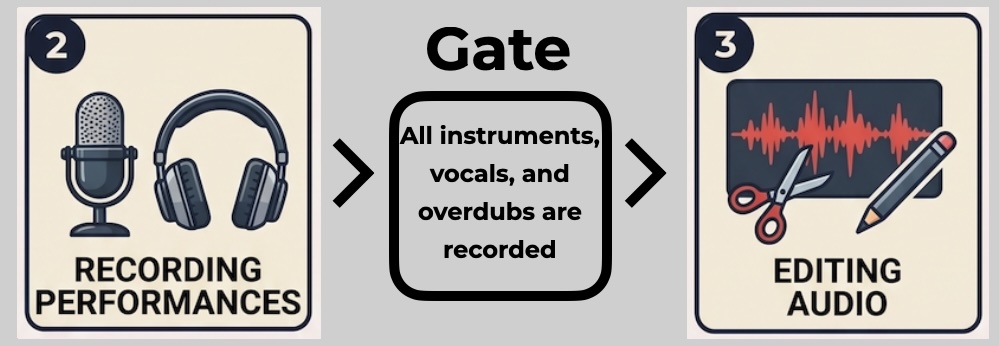
Performing + Recording
Where: In a recording studio and/or home studio
What's in focus: Musical performances above everything! Playing the song with a lot of feeling and vibe. Sense the other musicians while you perform your instrument, get lost in the magic of the moment. If it doesn't click immediately, try a slightly faster or slower tempo. Ignore your instrument for a moment, what tempo to the words and lyrics flow best. Try with click, try without - whichever feels best to all performers is the right thing to do.
Secondary focus should go into microphone choices, placement, gain staging... all the engineering stuff. Remember, your brain has got a capacity of 100% - if a large chunk of that is focusing on getting tracks ready, file managing, operating the DAW... how much capacity do you have left to perform your part? Delegate that part if you can.
What's NOT in focus: Production-trickery, complex effects, automation, mixing, mastering - don't even think about it! Avoid anything that gets your hand off your instrument, and your mind into a 'computer operator' mindset.
Technology: A recording rig - anything from home studio to complex Recording Studios. Record multitrack wav files (24 bit) into a DAW.
Editing
Where: In the recording studio and/or home studio
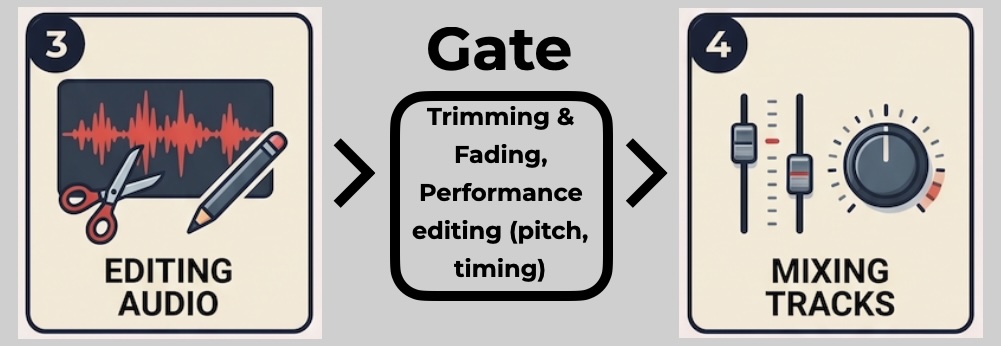
What's in focus: Editing might be a quick 5-min job or a day's worth of slicing individual drum beats - it completely depends on the song and genre.
If you're recording at home, try to get the editing done soon after recording, while the takes are still fresh in your memory. When I'm the studio engineer recording a band, I actually complete the majority of the editing in the recording session. Fair enough, I'm not performing an instrument so I have the capacity.
But at home, try to separate performing and editing wherever possible. That is because performing is a very creative, feel-based task where decisions come from the ear and from a gut-feeling - while editing is the polar-opposite mindset: rational, technical, graphical - driven by a visual cues, triggering the logical part of our brain. And once you've engaged that, it is really hard to find your way back into the creative mindset.
What's NOT in focus: Plugins. Automation. Competitive loudness relative to other music.
Technology: Computer and DAW
Mixing
Where: In the recording studio and/or home studio
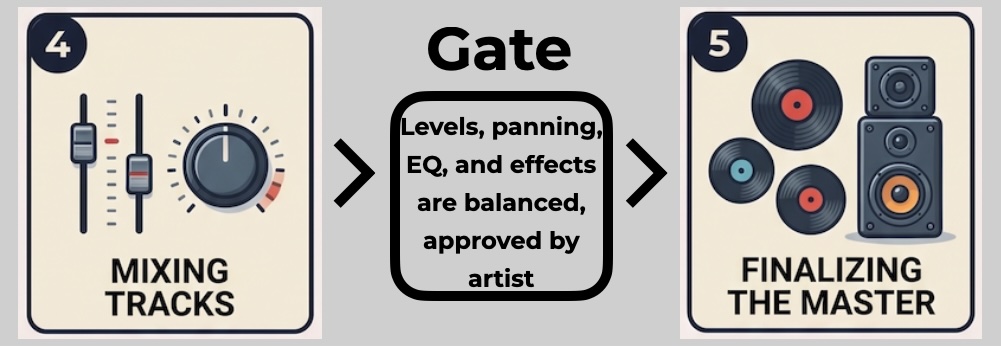
What's in focus: Blending all recorded performances into one beautiful sounding overall mix. Focus on balancing relative levels, eg. how loud is the bass in relation to the vocal (and how does that make me feel?). Stereo width and panning. Depth perception with reverbs and delays. Tonal separation, dark or bright. How the instruments lock-in with one another. Make sure all notes played are audible, without interfering/competing with one another. In a way, mixing is like cleaning up my kid's bedroom - declutter, organise, find a place where every element belongs.
In a mix, everything always affects everything else! Try bringing the snare up a bit, and focus how that makes the vocal sound different - it totally does! A mix is a bit like a house-of-cards - adding/removing cards can make it collapse easily. When mixing, you must have all signals to make good choices. IMHO, you cannot start the mix while still waiting for the other half of the recordings to arrive. You'd fill at the space available, not leaving the space needed for the signal you don't have yet.
My tip: Use the least amount of plugins/processors to get the job done. The more processors your stack, the more it disconnects from the emotion of the performance! Less plugins, more faders and pan pots. Magic happens when you use fewer compressors but more automation fader-rides.
What's NOT in focus: Competitive loudness relative to other music(!!!). Plugin chains recommended in YouTube videos - ignore those!
Technology: Computer and DAW, headphones, studio monitors in an acoustically treated mix room: export Wav files (24 bit or greater, no change in sample rate)
Mastering
Where: A professional mastering house (recommended), home studio (careful with that!) My tip: hire the most experienced, senior engineer you can afford. Someone who's a specialist at mastering.
What's in focus: While mixing blends a number of wav files into a cohesive sounding mix, mastering blends a number of mixes into a cohesive sounding album or EP. Therefore, give your mastering engineer all mixes for the album - do not drip feed singles, assuming those will make a cohesive album at the end! A good mastering engineer will give an album a cohesive sound and make it sound like a musical journey by balancing the levels and tone of each song in context to the songs before and after. Mastering engineers are very experienced in the album sequence, meaning the time-spacing between songs.
What's NOT in focus: Song arrangements, instrumentation, performances, mixing - all the previous production phases
Technology: Mastering grade speakers and acoustics. A mastering DAW.
Files: Discuss this first! Mastering engineers can provide wav files for streaming services, DDP files for Audio-CDs, pre-masters for Vinyl pressing etc.
Caution with AI mastering!
Yes, it can be cheaper and faster.
But be aware that AI mastering services will just compare your mix against the average of a large selection of published music (consent?), then process your music to match the average tone and envelope. Expect average outcomes - with ZERO creative choices.
A real mastering engineer has a sense of taste and will keep a sad ballade darker and quieter deliberately, understanding the musical context, flow and the listening journey that makes an album an experience to listen to.
AI cannot do that yet (and probably never will).
AI mastering may be sufficient for a rough demo - I wouldn't touch it for a release!
The human touch
Mastering can polish a gem, but it can't create one. The magic happens earlier - when you have the space, focus, and environment to capture great performances without wearing ten different hats.
Following a structured production flow doesn't just save time - it produces better-sounding records.
If you're ready to step into the studio and focus 100% on performing great music while leaving the technical heavy lifting to an expert...
Let's plan your next recording or mix phase.
Whether you need a dedicated recording space to capture peak performances while leaving the technical heavy lifting to an expert, or a mix that brings out the emotion, feeling, the heart and soul of your music, let's work together on your next release.